oversubscription
What is oversubscription?
Oversubscription in a storage area network (SAN) is the practice of committing more network bandwidth to devices connected to that network than what is physically available. This is typically achieved by designing the network's host and storage port configuration in a fan-in architecture in which the total host port bandwidth exceeds the available storage port bandwidth. Organizations use oversubscription to offset SAN infrastructure costs, but this approach must be carefully planned to ensure that that it does not degrade network performance.
In addition to its use in the storage sector, the term oversubscription is applied in other fields, including enterprise networking, server virtualization and finance.
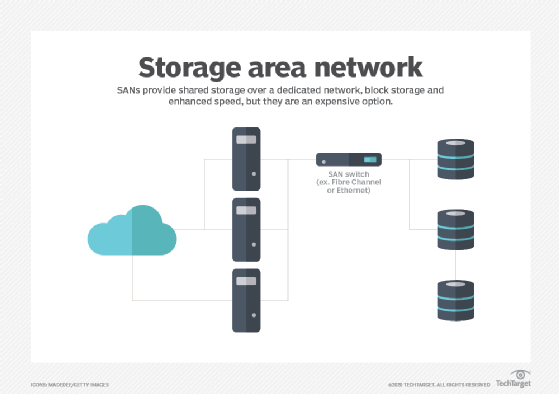
Oversubscription in a SAN environment
Oversubscription in a SAN environment operates under the assumption that the connected application servers are not likely to flood the network with the maximum amount of traffic all at the same time. In a SAN configuration, each port is limited to a maximum bandwidth, such as 10 gigabits per second, 25 Gbps, 40 Gbps or 100 Gbps. However, a port rarely runs at its maximum speed for a prolonged period, making it possible for other traffic to take advantage of unused capacity.
For example, the following figure shows a simplified version of a SAN environment configured in a fan-in architecture. In this case, eight application servers connect to a SAN switch. Each server is configured with a 25 Gbps port that connects to one of the 25 Gbps switch ports. The switch also includes a 40 Gbps uplink port that connects to the storage system.
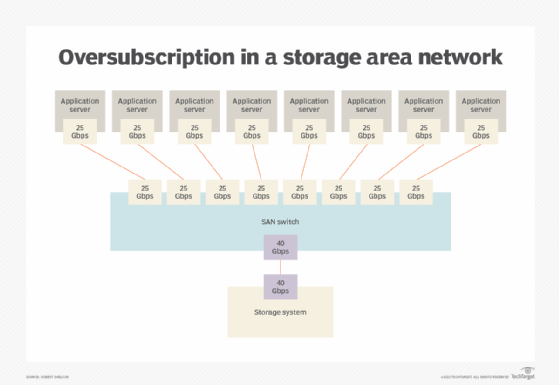
In this configuration, the switch has committed 200 Gbps of bandwidth to the eight application servers. However, the switch includes only one 40 Gbps uplink port, which connects to the storage system. In other words, the committed host bandwidth is 200 Gbps per switch, but the available storage bandwidth is only 40 Gbps. The uplink port and storage connection are said to be oversubscribed because the committed host bandwidth exceeds that of the available storage bandwidth.
SAN oversubscription pluses and minuses
Oversubscription makes good technical and financial sense. Setting up the host and storage ports in a one-to-one configuration requires more switches, which are expensive. Oversubscribing the SAN ports can save money by reducing the total number of switches that need to be configured and maintained, while maximizing the use of available network resources.
But there's also a downside. When multiple hosts connect to the same storage port, they might have to contend for bandwidth during periods of heavy traffic, resulting in poor response times and compromised application performance. When considering oversubscription, SAN designers should understand the bandwidth, input/output and response times demanded by the running workloads. Servers and storage systems that support applications with high bandwidth and performance requirements should generally connect to the network using a one-to-one port configuration.
However, a one-to-one port configuration is not always practical. In that case, oversubscription can be a useful strategy. When planning oversubscription, designers should aim to keep the ratio of committed host bandwidth to available storage bandwidth as low as possible. An oversubscription rate of 1-to-1 indicates that the committed host bandwidth and physical storage bandwidth are the same, which means there should be no network bottlenecks, at least not as a result of oversubscription. However, a ratio of 4-to-1 means that the committed host bandwidth is four times that of the available storage bandwidth. As a result, the network can handle only a quarter of the traffic if all the application servers are running at full throttle at the same time.
Designers can calculate the oversubscription ratio by dividing the committed host bandwidth by the available storage bandwidth. For example, in the preceding example, the switch has committed 200 Gbps -- 8 times 25 Gbps -- to the application servers. However, the maximum available storage bandwidth, as determined by the uplink connection, is 40 Gbps, which means that the oversubscription ratio is about 5-to-1 (host capacity to storage capacity).
Some SAN environments are designed with much higher oversubscription ratios than the one in this example. Others are designed with lower ratios. There is no one ratio that suits all SAN environments. Although a 1-to-1 ratio might seem the ideal approach, it can also represent a significant waste of SAN resources, depending on the supported workloads and switch cost. On the other hand, if the ratio is too high for those workloads, network services and application delivery could be severely disrupted. Oversubscribing a network can be an effective strategy for maximizing a SAN investment, as long as it's implemented with careful consideration.
See also five factors to consider for Fibre Channel vs. iSCSI, the best data center network topology, choosing the right storage management interface for you, the key differences of SAN vs. NAS, storage networking technologies explained and signs it's time for a NAS or SAN upgrade.