What's the difference between a hot site and cold site for DR?
The hot site vs. cold site debate requires users to understand how each DR site works and the resources needed. While one is more budget-friendly, downtime can be a deciding factor.
Having a recovery site for your organization's data in case of disaster is essential. An off-site location to recover data and resume operations helps to maintain business continuity and prevent data loss when the worst-case scenario occurs and should be a key element of any disaster recovery plan.
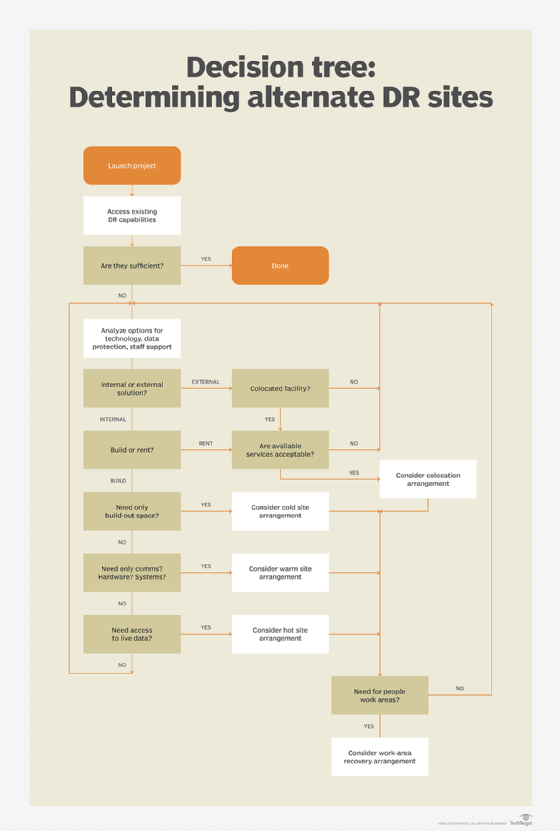
While the cloud is gaining momentum in the recovery space, hot site and cold site use for business continuity and disaster recovery (BC/DR) remains prevalent. Essentially, hot and cold sites are two backup options you can have available for remote data recovery with different levels of work involved. While a hot site is a copy of a data center with all of your hardware and software running concurrently with your primary site, a cold site is stripped down -- no server hardware, no software, nothing. Having a cold site available is basically renting the space you'll need for a data center without any of the equipment. There are also warm sites that reside between a hot site and cold site from an equipment standpoint.
Costs will likely play a key role in which type of site your organization picks. Before deciding on one or the other for your DR plan, it's important to understand how each type of DR site works, what resources each one requires and where your organization's priorities lie in the event of a significant outage. From initial costs to staffing needs, there are many factors to consider when deciding between a hot site and cold site for DR.
How a hot site works
A hot site is a DR location that is set up and ready to go -- that is, one can arrive and continue to work immediately. A hot backup site will have equipment set up with your current data available when you walk in, with all primary data center functions copied and maintained off site.
Because everything is meant to be up and running at a moment's notice, a hot site is the better option for mission-critical data. While having a DR site actively working in addition to a primary data center is costly, those additional costs pay off in providing redundancy when disaster strikes. Depending on the industry, this urgency may vary, but in an age where any downtime can be considered unacceptable, hot sites are an increasingly popular option.
A hot site has copies of all critical servers, as well as some staffing on hand for managing and monitoring equipment.
How a cold site works
Unlike a hot site, which is available and running 24/7, a cold site is essentially available space with little, if anything, set up in it. When you arrive at a cold backup site, you need to set up the equipment, make all connections, load the software, etc. Until DR services are activated, only basic power, communication services and environmental controls for the IT system are installed.
Cold sites are unused until a disaster occurs. There is typically a strategy in place for rapid setup of a cold DR site, but prior to a disaster occurring, there are no resources physically in place or actively running. Periodic backups are often done in preparation for using a cold DR site, so the data can be recovered when the site is put to use.
Because of their bare-bones infrastructure, cold sites keep costs down. They tend not to be used for mission-critical data, where rapid access may be required. While a hot site usually only requires basic personnel to make sure equipment is running properly, a cold site will need to have technical staff available for setup.
Key differences and similarities
Hot and cold sites both provide secure off-site locations that will be unaffected by most physical disasters that can cause failure, such as extreme weather or fire. Both of these facilities are equipped with basic heating, ventilation, air conditioning and power functions, as well as communications equipment.
Hot sites and cold sites are available as either internal options or external services in various formats. If the resources are available, organizations can have an internal hot site, which can be a backup data center or field office. These field offices can also be used as cold sites; maintaining field offices or office space without server hardware or software is another internally owned way for an organization to have a plan for disasters without a full copy of a data center. There are also vendors that provide equipment or dedicated or shared spaces for hot or cold sites.
The primary difference between a hot site and cold site is the readiness to be up and running. With a recent backup of data and all IT systems operating, a hot site provides redundancy and is essentially a second data center that will result in minimal to no downtime. To get a cold site up and running means planning for setup time and resources.
Warm sites
If your industry does not allow for downtime in recovering data, it could be detrimental to settle on a cold site.
A warm site is an intermediary facility between a hot site and cold site; equipment is available and set up for you, but you must load or restore your latest data to the system. When DR services are activated, a warm site will already be equipped with basic server hardware, software and personnel, and the organization may bring and set up additional resources.
While a hot site has equipment and customer data included, a warm site has no customer data preinstalled. If an organization wants to reduce costs but not have to start from scratch with an off-site data center, a warm site is a compromise between the two extremes.
Determining which is best for your needs
Deciding between a hot site and cold site can become a difficult process, depending on your priorities. If your priority is cutting costs, then you probably would want to go with a cold site. However, if your industry does not allow for downtime in recovering data, it could be detrimental to settle on a cold site.
Before you choose a disaster recovery site, you must consider your recovery time objective (RTO) and recovery point objective (RPO) data. If your RTO is short -- fewer than three hours -- a hot site is a good option because systems and configurations are already set to your specific requirements. But to get this privilege, you will need to pay a premium, making hot sites the more expensive DR site option.
If you have a long RTO -- more than 18 hours -- a cold site enables you to configure your equipment and telecommunications, as well as test the system. So, although the setup time is longer for cold sites, it may not have any effect on you if you have a long RTO -- plus, they are the less expensive option.
A warm site could be considered the compromise between the two, but if having a low RTO and RPO is a priority, a hot site is likely worth the extra expense.
Dig Deeper on Disaster recovery planning and management
A terabyte comprises more than 1 trillion bytes. Discover how the storage measurement scale was created and where a terabyte stands among other units...
Continue Reading
It's critical for an organization to know what data it needs to retain and where to store it. Some data is required for retention by law, so a ...
Continue Reading
When disaster strikes an organization, employees must be alerted. Using a call tree in emergency situations is a time-tested way to effectively ...
Continue Reading