mirror site

A mirror site is a website or set of files on a computer server that has been copied to another computer server so that the site or files are available from more than one place. A mirror site has its own URL, but is otherwise identical to the principal site. Load-balancing devices allow high-volume sites to scale easily, dividing the work between multiple mirror sites.
A mirror site is usually updated frequently to ensure it reflects the contents of the original site. In some cases, the original site may arrange for a mirror site at a larger location with a higher speed connection and, perhaps, a closer proximity to a large audience.
If the original site generates too much traffic, a mirror site can ensure better availability of the website or files. For websites that offer copies or updates of widely used software, a mirror site allows the site to handle larger demands and enables the downloaded files to arrive more quickly. Microsoft, Sun Microsystems and other companies have mirror sites from which their browser software can be downloaded.
Mirror sites are used to make site access faster when the original site may be geographically distant from those accessing it. A mirrored web server is often located on a different continent from the principal site, allowing users close to the mirror site to get faster and more reliable access.
Mirroring a website can also be done to ensure that information can be made available to places where access may be unreliable or censored. In 2013, when Chinese authorities blocked access to foreign media outlets like The Wall Street Journal and Reuters, site mirroring was used to restore access and circumvent government censorship.
Port mirroring
Port mirroring allows network administrators to analyze data, monitor traffic and diagnose network problems. By placing a protocol analyzer on a port, administrators can keep track of switch performance.
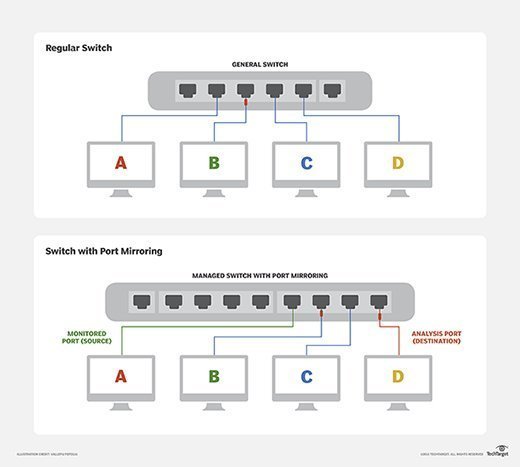
When port mirroring is enabled, a switch sends copies of all network packets from one port to another to be analyzed. Different switch manufacturers have their own names for port mirroring, including Switched Port Analyzer, as coined by Cisco.
Content delivery network
Mirroring could be considered a static form of content delivery. Similar to a mirror site, a content delivery network (CDN) exists as multiple copies on servers in different locations around the world. Like a mirror site, a CDN allows for easier access to content from geographically diverse locations.
Even when bandwidth is limited, a CDN can meet requests such as delivering streaming audio and video content. However, a CDN is not an exact replica of a site, but caches content from the original site.