tape drive

What is a tape drive?
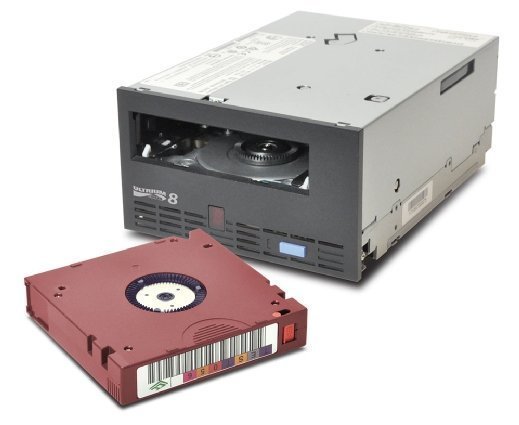
A tape drive is a device that stores computer data on magnetic tape, especially for backup and archiving purposes. Like an ordinary tape recorder, a tape drive records data on a loop of flexible celluloidlike material that can be read and also erased.
Tape drives work either by using a traditional helical scan where the recording and playback heads touch the tape, or linear tape technology, where the heads never actually touch the tape. Drives can be rewinding, where the device issues a rewind command at the end of a session, or non-rewinding.
Rewinding devices are commonly used when a tape must be unmounted at the end of a session after batch processing large amounts of data. Payroll is the classic example of this use. Non-rewinding devices are useful for incremental tape backups and other applications where new files are added to the end of the previous session's files.
Tape drives differ from hard disk drives (HDDs) and solid-state drives (SSDs) in the way data is read and written to the storage media. Tapes store data sequentially, whereas HDDs and SSDs use rotating disks with rapidly moving seek heads, nonmoving flash memory or similar technology to transfer data.
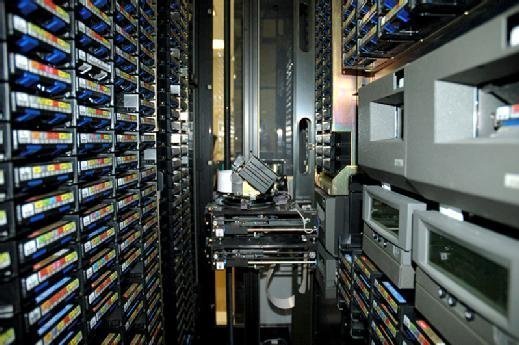
Drives come in many sizes and capabilities. They are sold as standalone units or stacked in data center racks, creating tape libraries. The tapes themselves are often housed in sealed cassettes that can be inserted into the drive and activated.
Strengths and limitations of tape drives
There are several benefits to using tape drives, particularly for backup and archival uses. They include the following:
- Capacity. Tapes have a large capacity for storing data when compared to HDDs.
- Low cost. They are economical when compared to other storage media.
- Life span. Tapes stored in a suitable environment can last for decades, an important factor for archival storage.
- Transportable. Tapes can be easily moved from one location to another and are considered off-line storage.
- Security. Today, tapes support encryption such as Advanced Encryption Standard-256 and provide varying levels of data protection.
- Disaster recovery. Tape is often the storage medium of choice for data backup and DR. Storing critical systems and data on tape creates an air gap between systems that are at risk from cyber attacks simply by removing the tape cassette from the drive.
Some drawbacks of tape technology include the following:
- Sequential storage. Tape drives use a sequential access approach to reading and writing data. That means they must start at the beginning of the tape and roll through it to access specific data or write new data.
- Shoe-shining. Tape drives spin fast. When the drive finds the data it needs to transfer, the tape must stop and back up to the point where the data is. This start, stop and backup action can continue a few times until the proper location is reached. The motion of the drive resembles the back and forth action of shining a shoe. Excessive shoe-shining slows a drive's response time, wears out the tape and drive, and shortens the life span of both.
- Start-stop operation. Data to be stored on tape typically accumulates in buffers prior to being streamed onto tape. If the buffers are not full, the tape may be stopped and positioned for the next delivery of data from the buffers. This cuts into the drive's overall processing efficiency.
What are the primary tape drive technologies?
Tape systems access data sequentially. In the early years, that factor resulted in slower read/write speeds. Today, two primary tape technologies -- linear tape and helical scan systems -- have advanced tape performance, making it comparable to disk drive systems. While these technologies have improved drive performance, they are largely incompatible with each other.
Linear tape
Linear tape technology has parallel tracks of data that extend the length of the tape. Multiple read/write heads operate in parallel, reading and writing data simultaneously. Tape cartridges consist of one tape spool. When the cartridge is inserted, the end of the tape connects into a take-up spool inside the device. Linear tape media is approximately a half-inch wide.
Helical scan
Helical scan systems write data in diagonal strips along the tape and use two tape reels in the same cartridge with a quarter inch-wide tape media. This technology provides greater data storage density than linear tape. However, the helical scan cartridges may store less data than linear tape models.
What tape formats are in use?
For linear tape drives, the primary format is Linear Tape-Open, which is also called LTO Ultrium. Hewlett Packard, IBM and Quantum jointly developed this format as part of the LTO Consortium. It's an open standard that any tape drive manufacturer can license.
Along with the LTO specification, the Linear Tape File System lets users view and access tape files the same as with disk-based media files. LTO partitions the tape with a content index and the actual data. This arrangement speeds up the read/write capabilities of linear tape systems.
Helical scan drives are still available. However, linear tape drives have largely surpassed them in terms of performance, cost and convenience.
Evolution of tape drives
Tape drives were introduced in the early 1950s, with the emergence of data processing in the enterprise. Over the years, tape and magnetic tape have gone through many iterations to improve storage capacity and speed of access to stored data.
Through the 1970s, these drives were manually mounted and the tape threaded through the drive components. Today, drives are more compact. They connect directly to computers, storage area networks, and other devices and systems. The large reel-to-reel tape drives seen in 1950s and 1960s movies are still in use, but they are mostly for long-term archival storage.
Today, drives use sophisticated approaches that increase storage capacity into multiple terabytes and provide data transfer rates as fast as 400 megabytes per second.
Learn about the latest advances in tape technology, who is using it, what they are using it for and what's coming next.