hybrid hard drive (HHD)

A hybrid hard drive (HHD), sometimes known as a solid-state hybrid drive (SSHD), is a mass storage device that combines a conventional hard disk drive (HDD) and a NAND flash module. An HHD blends the capacity, cost and performance of physical disk storage with the accelerated performance of flash.
Data that is frequently written to or retrieved from storage is served from flash memory. Seagate Technology, Toshiba Corp. and Western Digital Corp. offer variants of hybrid hard drive technology, typically branded using the SSHD moniker, for particularized consumer use in notebook computers and personal digital assistants.
Hybrid hard drives vs. SSD vs. hard drives
Hybrid hard drives attempt to bridge the gap between flash and fixed-disk Magnetic storage. SSDs are faster than traditional rotational media, but have much lower storage capacities than HDDs.
An HDD uses stacks of electromechanical spinning platters to store nonsequential data, written to sectors within specified blocks on each disk via an actuator arm. The HDD positions a hard disk so data is read and written on the correct disk sector. The HDD mechanism and hard disk are packaged as an integrated unit, although both terms are used to describe it.
Engineers at IBM in the 1950s created the hard disk to provide random access to high capacities of data. Doing so at an affordable cost was one of IBM's key design criteria. Disk density has increased greatly from IBM's original 3.75 megabyte (MB) device. Seagate said it plans to introduce a 16 terabyte (TB) HDD in 2017.
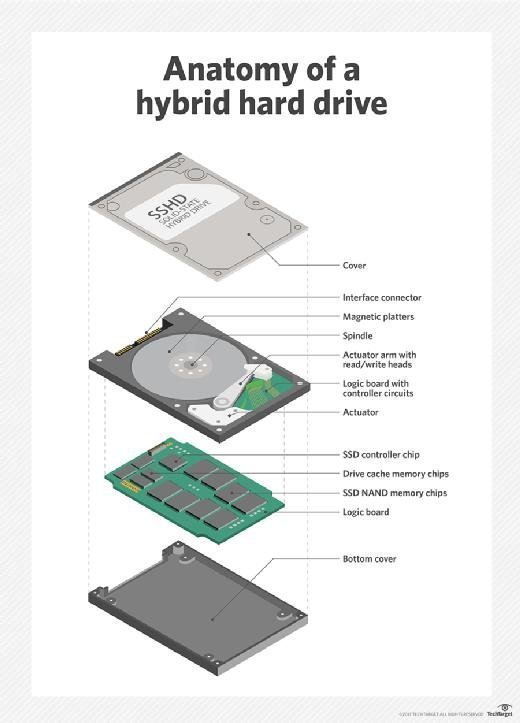
HDDs connect to computing devices via a serial-attached SCSI (SAS) or Serial Advanced Technology Attachment (SATA) interface. Similarly, SSDs (also known as flash drives) are based on SAS or SATA form factors, but they have no internal mechanical movement. SSDs consist of silicon chips designed as an integrated circuit to provide nonvolatile memory for resilience. This differs from volatile storage on HDDs, which require an onboard capacitor or battery backup to protect data in the event of a system failure.
A hybrid hard drive adds a small dose of flash to the core disk architecture. The NAND cache buffer stores hot data and serves it to disk to accelerate application workloads. A typical HHD cache volume contains about 8 gigabyte (GB) of flash and requires no special software driver.
An SSHD/hybrid hard drive with embedded flash costs a fraction of an SSD, yet can give similar performance benefits. That value may diminish over time in tandem with falling flash prices.
Pros and cons of hybrid storage products
Hybrid hard drives deliver distinct advantages compared to a conventional hard drive, namely the ability to:
- accelerate data storage and retrieval for applications such as word processors,
- reduce time for system boot,
- reduce power consumption,
- decrease heat generation,
- extend hard drive life,
- extend battery life for notebooks and PDAs, and
- diminish levels of operating noise.
Limitations of HHDs include:
- Longer seek time for data stored on the hard drive
- More frequent HDD spin up and spin down
- Impossibility of data recovery from failed flash memory modules
- Higher overall hardware cost for the system
Major hybrid hard drive vendors
Seagate sells the Laptop SSHD (formerly Momentus XT), Desktop SSHD, Turbo SSHD, and BarraCuda and FireCuda SSHDs for mostly consumer use cases. The company recently upgraded its FireCuda SSHD line with 1 TB and 2 TB capacities, targeting high-performance desktop workstations and PC gaming. Seagate's Desktop SSHD models scale from 1 TB to 4 TB.
For enterprises, Seagate's Turbo SSHD storage targets virtual desktop infrastructure, online transaction processing and legacy databases such as SAP Hana. Turbo SSHDs are available in 300 GB, 450 GB and 600 GB capacities. Enterprises concerned with drive security have the option to purchase Seagate self-encrypted SSHDs.
Western Digital Blue SSHDs come in 1 TB and 4 TB capacities, with 6 gigabit per second (Gbps) SATA connectivity. Blue SSHD products attempt to straddle consumer and enterprise workloads. Acronis True Image WD Edition backup software is available as a free download to clone drives and back up applications, operating systems and drive settings.
Toshiba sells the MQ01ABD and MQ01ABF SSHD lines that scale from 500 GB to 1 TB, designed with its own NAND flash chipset. Toshiba's hybrid hard drives target portable computing, notebooks and gaming applications.
Hybrid flash overshadows hybrid hard drives
Integrating flash storage directly on disk was conceived as a way to speed data access across all storage. The combination of low cost and high performance led industry analysts to believe hybrid hard drives eventually would supplant traditional hard drives and SSDs, but enterprises have not warmed up to the technology.
A major reason for this is the emergence of hybrid arrays, which mix SSDs and magnetic disk at the drive level. That allows vendors to build arrays from commercial off-the-shelf hardware, with intelligent software to manage caching and data tiering.
As a result, most HHD shipments remain oriented toward the consumer market, such as hybrid drives to replace legacy rotating media in laptops and PCs.