kibi, mebi, gibi, tebi, pebi and exbi

What are kibi, mebi, gibi, tebi, pebi and exbi?
Kibi, mebi, gibi, tebi, pebi and exbi are binary prefix multipliers that, in 1998, were approved as a standard by the International Electrotechnical Commission (IEC). This was done in an effort to eliminate the confusion that sometimes occurs between decimal (power of 10) and binary (power of 2) numeration terms.
The prefix multipliers kilo- (k or K), mega- (M), giga- (G), tera- (T), peta- (P) and exa- (E) are commonly used, but they can be ambiguous when referring to data quantities. In most of the physical sciences and when describing quantities of objects in general, these multipliers refer to decimal (base 10) amounts. However, when used to define data quantities in terms of bytes, they might refer to binary (base 2) or to decimal, and it can be difficult to know which standard is being used.
For example, a computer's operating system (OS) might use the binary standard when reporting a hard drive's capacity, but the storage vendor might use the decimal standard in the drive's specifications. In the early days of computing, the discrepancies between the decimal and binary standards did not amount to much because data quantities were so low. But, as storage devices and data quantities have increased in size, the differences between the two standards are now much more apparent.
For instance, a vendor might report that a storage device can hold 1 terabyte (TB) of data, but the computer's OS indicates that the drive can hold only 931 gigabytes (GB) of data. Here, the vendor is using the decimal system, and the OS is using the binary system. The table below shows the differences in quantities between the decimal and binary systems for some of the more common prefixes.
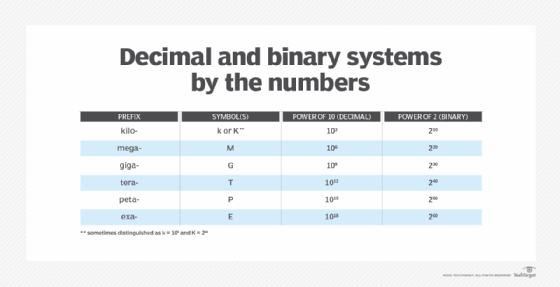
As data quantities grow, the discrepancies between the two standards become more apparent. For example, 1 kilobyte in the decimal standard equals 1,000 bytes, but in the binary standard, 1 KB equals 1,024 bytes. In this case, the difference is only 24 bytes, which is not much when compared to the amount of data now being generated.
However, 1 TB in the decimal standard equals 1,000 GB, but in the binary standard, 1 TB equals 1,024 GB, resulting in a difference of 24 GB, which can represent a significant amount of data or storage capacity. If an organization misplaced 24 GB of personally identifiable information, it could be subject to stiff penalties for being out of compliance and perhaps face costly lawsuits.
To help eliminate the confusion that comes with prefix multipliers, the industry has been steadily adopting the IEC standards when referring to quantities in binary. The table below shows a breakdown of some of the more common IEC prefixes now in use, along with their symbols.
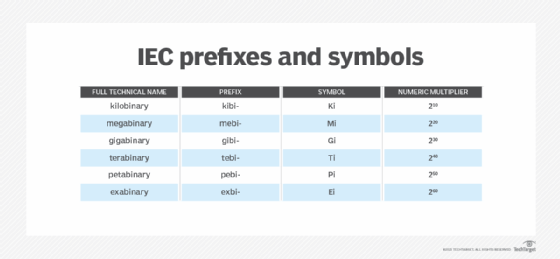
In scenarios such as the one mentioned above, if the IEC binary prefixes are used, it becomes much easier to understand the discrepancies between how data and storage amounts are reported. For example, if the OS uses the IEC prefixes, it reports the drive's capacity as 931 gibibytes (GiB), as opposed to the storage vendor's 1 TB. The same holds true when referring to data transfer speeds. A network connection might support speeds up to 10 megabits per second (Mbps), which is equivalent to 10,000 kilobits per second (Kbps), or it might support speeds up to 10 mebibits per second (Mibps), which is equivalent to 10,240 kibibits per second (Kibps).
The following measurements help to illustrate the differences between decimal and binary data amounts:
- 1 KB equals 1,000 bytes; 1 kibibyte (KiB) equals 1,024 bytes.
- 1 megabyte (MB) equals 1,000 KB; 1 mebibyte (MiB) equals 1,024 KiB.
- 1 GB equals 1,000 MB; 1 GiB equals 1,024 MiB.
- 1 TB equals 1,000 GB; 1 tebibyte (TiB) equals 1,024 GiB.
- 1 petabyte (PB) equals 1,000 TB; 1 pebibyte (PiB) equals 1,024 TiB.
- 1 exabyte (EB) equals 1,000 PB; 1 exbibyte (EiB) equals 1,024 PiB.
Based on a suggestion from the National Institute of Standards and Technology (NIST), the first syllable of the name of the binary-multiple prefix should be pronounced the same way as the first syllable of the name of the corresponding International System of Units prefix, and the second syllable should be pronounced as bee. Thus, kibi would be pronounced KIH-bee; mebi would be MEH-bee and so forth.
Learn how the storage measurement scale was created and how terabytes compare to other byte measurements, including petabytes, yottabytes and brontobytes.
Also see kilo, mega, giga, tera, peta, exa, zetta and all that.