IDE (Integrated Drive Electronics)
What is IDE (Integrated Drive Electronics)?
IDE (Integrated Drive Electronics) is an electronic interface standard that defines the connection between a bus on a computer's motherboard and the computer's disk storage devices. The IDE interface was originally based on the IBM PC Industry Standard Architecture 16-bit bus standard, but it has since been implemented in computers that use other bus standards.
In November 1990, the American National Standards Institute (ANSI) standardized the IDE technology, referring to it as Advanced Technology Attachment (ATA). The ATA standard is maintained by the T13 Committee of the International Committee on Information Technology Standards, an ANSI-accredited forum for creating technology standards.
The IDE technology was developed in the 1980s by Western Digital and Compaq as part of an effort to combine the storage controller and drive into a single device. After ANSI standardized the technology, the terms ATA and IDE started to be used interchangeably. Since then, it has become a generally accepted practice to treat them as one in the same, even if it could be argued that they are not.
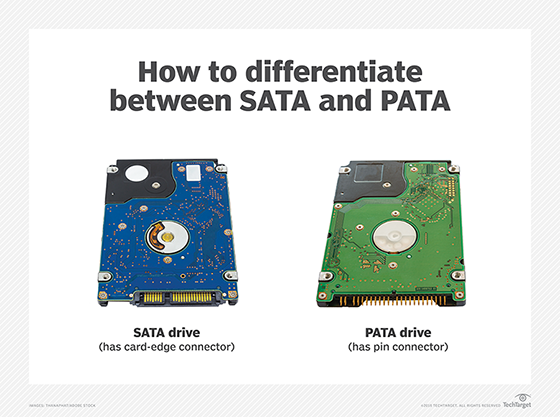
The introduction of Serial ATA (SATA) -- the command and transport standard that succeeded the first ATA -- only muddied the waters further. The new standard brought with it a renaming of the original interface from ATA to Parallel ATA (PATA) because it's based on parallel signaling technology, whereas SATA is based on serial signaling technology.
Despite the new label, many continued to use ATA to refer to the first interface, while others started to use PATA. Vendors often use ATA to refer to the original technology. For example, Apple uses ATA when describing resources on a Mac computer.
At the same time, it's still quite common for the terms IDE and ATA to be used interchangeably. As a result, IDE, ATA and PATA have all come to refer to the same technology, which continues to cause confusion across the industry. Only SATA stands apart from the others, even though it can be considered a type of ATA.
What is an IDE interface?
An IDE interface is an industry-standard adapter for connecting IDE devices and enabling them to communicate with each other. At one time, most computers included at least one IDE interface built into the motherboard. The interface provided a 40-pin connector for attaching an IDE hard disk drive (HDD) to the computer. A flat ribbon cable connected the drive to the motherboard by attaching to the IDE interfaces on the computer and HDD.
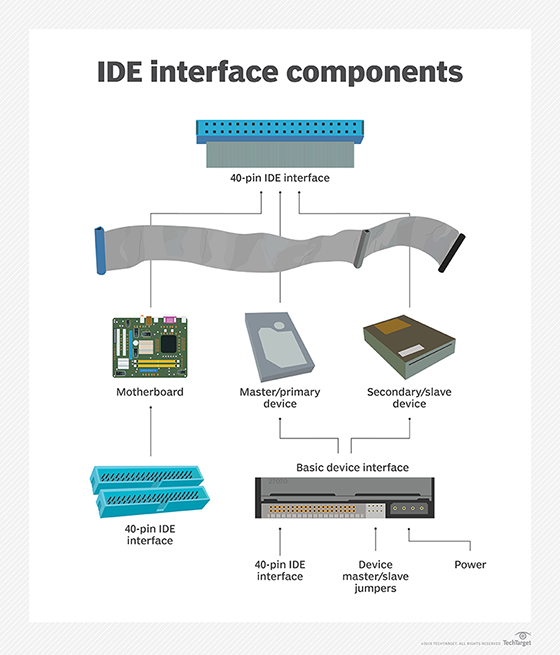
The IDE interface standard grew out of the effort to combine a storage controller and the storage disk into a single unit. Before that, controllers and disks were implemented as separate devices, often built by different manufacturers. Not only did this result in integration issues, but the distance between the two could impact performance.
IDE changed this by providing an interface that supports HDDs with integrated controllers.
The IDE interface was originally developed for HDDs, but it evolved to include floppy and tape drives, as well as various types of compact disc (CD) and digital video disc drives. A single IDE interface and ribbon can support two devices. In this configuration, one device is designated as primary, or leading, and the other device is designated as secondary, or alternative. In this way, two drives can share the same cable without conflict.
Many computer motherboards came with two IDE interface connectors, in which case, one was designated as primary and the other as secondary. The primary connector could support primary leading and primary alternative, and the secondary connector could support secondary leading and secondary alternative.
ATA standards
When first launched, the ATA interface helped to standardize the original IDE technology introduced by Western Digital and Compaq. Since then, updated versions of the standard have been regularly released to incorporate new and changing technologies.
ATA-1
This first standard, which was developed by Western Digital, Compaq and Control Data Corp., introduced 40- and 44-pin connectors and the leading/secondary configuration model. It also defined multiword Direct Memory Access (DMA) mode 0 and Programmed Input/Output (PIO) modes 0, 1 and 2. ATA-1 is now considered obsolete.
ATA-2
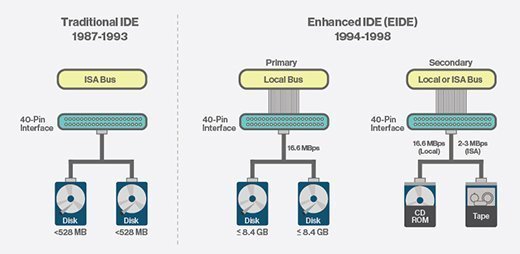
Also known as Enhanced IDE, ATA-2 added PIO modes 3 and 4 and DMA modes 1 and 2. This version also added support for device types other than HDDs, and it increased transfer rates and storage capacities.
ATA-3
This ATA version improved the reliability of high-speed transfers and added Self-Monitoring, Analysis and Reporting Technology. This version also introduced password protection to better control drive access.
ATA/ATAPI-4
Also known as Ultra DMA/33, this version added ATA Packet Interface (ATAPI) to the standard, making it possible to support additional device types, such as CD read-only memory drives and tape systems. This version also increased data transfer rates to 33 megabytes per second (MBps), and it added support for an 80-conductor, 40-pin ribbon cable.
ATA/ATAPI-5
Also called Ultra ATA/66, this version increased data transfer rates to 66 MBps when used with the 80-conductor cable.
ATA/ATAPI-6
This version added support for Ultra DMA/100, which increased data transfer rates to 100 MBps. ATA/ATAPI-6 also included automatic acoustic management, which enabled drives to automatically adjust access speed to reduce running noise.
ATA/ATAPI-7
This version incorporated SATA into the standard. SATA supported transfer rates up to 150 MBps and used 7-pin connectors and ribbon cable to connect SATA drives. In addition, ATA/ATAPI-7 increased transfer rates for PATA to 133 MBps. This version also split the standard into three volumes. The first volume defined the register delivered commands that devices use, the second volume focused on PATA and the third volume was concerned with SATA.
ATA/ATAPI-8
This version builds on ATA/ATAPI-7 and is the most recent version to be published. It includes SATA 2.x and 3.x and increases SATA transfer rates to 600 MBps, but it leaves PATA transfer rates at 133 MBps. This version also adds new flash-based solid-state drive capabilities and includes other revisions for both PATA and SATA.
Alternate IDE definition
IDE can also stand for integrated development environment.